


Aluminum surface treatments for industrial applications
Which aluminum surface treatment extends the service life of your components?
The right layer based on specifications, requirements and application
At Mifa, a layer is selected based on specifications and requirements. In addition, we advise on coatings per industrial application to achieve the best end result. Recommendations are supported with test coatings, batch reports and advice per drawing.
Mifa provides advice on a suitable coating for industrial applications or conditions such as:
- Wear resistance for moving or mechanically loaded parts.
- Corrosion protection in humid, marine or chemical environments.
- Optical quality or electrical insulation for visible and functional parts.
Use our Surface Selector to receive suitable advice for your component!
The Surface Selector
Which aluminium coating is best suited to your needs? Based on your application and the properties you require, we can advise you on the most suitable surface treatment.
Try our Surface Selector and receive personalised advice.
From wear resistance and corrosion protection to Cr6-free solutions and visual requirements: together we will find the treatment that suits you best.
Start with The Surface Selector

Measurable benefits
We recommend surface treatments that safeguard both performance and tolerances for industrial applications such as machine building, semiconductor equipment, automation/robotics and lighting. This keeps components in top condition for longer.
The measurable benefits of surface treatments are diverse. Examples include:
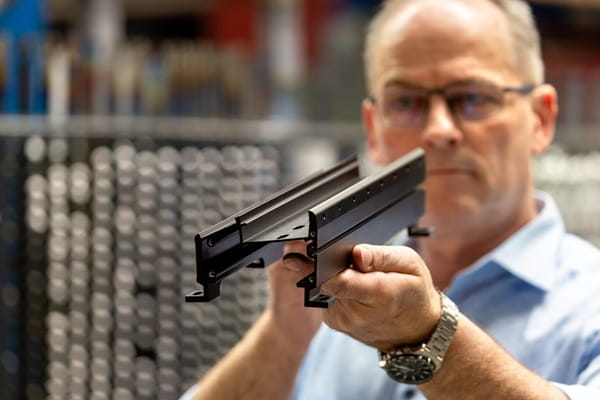
- Uptime focus: service life improves significantly on grippers and guide rails (linear motion), validated on the actual component.
- Chemical resistance: resistant to cleaners and cooling/lubricating fluids.
- Pre‑treated for assembly: for spraying and bonding processes, adhesion according to Class 1 (cross‑cut) is used as a quality standard.
- Corrosion resistance in wet/chemical environments: depending on layer/alloy.
- Dimensional stability in series: fit adjusted to layer thickness; deviations <10 μm possible, including batch report.
-
What is the best coating for both wear and corrosion?
In many cases, TUFRAM® or electroless nickel. Mifa validates the optimal choice based on your specific profile and application environment. -
Can I combine a coating with anodising?
Yes. In certain situations, layers are combined. An example is combining TUFRAM® with sealing. The build‑up is always tested first. -
What is the impact of coatings on dimensional tolerances?
Dimensional stability is included in the design. Deviations <10 μm are feasible and are defined in advance in the reporting. -
Are alternatives to Chromium‑6 equally strong?
Yes, with proper pre‑treatment and validation, REACH‑compliant alternatives, like Surtec650, deliver equivalent performance. Mifa already applies this for various customers. -
Which alloys are suitable for industrial applications?
Mainly 6xxx and 7xxx alloys are suitable. Assessments, adhesion and roughness tests are performed per application. For the right alloy for your application, please contact our engineers.

Questions or advice needed about aluminium surface treatments for the industry?
Call Fons
Manager Surface Treatment